
In industrial piping systems, pipe fittings serve as core components for connections and directional changes. Their material properties directly determine the system’s stability and service life under complex operating conditions. Incoloy 825 butt weld fittings, with their exceptional corrosion resistance, outstanding high-temperature strength, and reliable welded sealing, have become the preferred choice for conveying corrosive and high-temperature media in chemical, offshore engineering, and energy sectors.
You can click here to learn more about Incoloy 825 products
What are Incoloy 825 Butt Weld Fittings?
Incoloy 825 is a nickel-iron-chromium alloy with added elements such as molybdenum, copper, and titanium. This unique chemical composition grants it exceptional corrosion resistance in both oxidizing and reducing environments.
Butt-weld fittings are pipe components connected to pipelines via butt welding. This connection method creates a seamless, robust, and leak-proof joint, ensuring the overall integrity of the piping system. It is particularly suitable for high-pressure, high-temperature, or cryogenic environments.
The combination of Incoloy 825 material with butt-welded connections makes Incoloy 825 butt-welded pipe fittings a reliable piping solution capable of delivering dependable performance under extreme corrosion and high-pressure conditions.
Incoloy Alloy 825 Butt weld Fittings Specification
Specifications ASTM B366 / ASME SB366
Dimensions ASME/ANSI B16.9, ASME B16.28, MSS-SP-43, MSS SP-79
Size 1/8” NB TO 48” NB. (Seamless & 100% X-Ray Welded, Fabricated)
Type Seamless / Welded / Fabricated
Bending Radius R=1D, 2D, 3D, 5D, 6D, 8D, 10D or Custom
Thickness Sch 5s, Sch 10s, Sch 40s, Sch 80s, Sch 160s, Sch XXS
Grade 825 UNS (N08825), DIN (2.4858)
Equivalent Grades of Incoloy 825 Buttweld Fitting
| STANDARD | UNS | WERKSTOFF NR. | AFNOR | EN | JIS | BS | GOST | OR |
| Incoloy 825 | N08825 | 2.4858 | NFE30C20DUM | NiCr21Mo | NCF 825 | NA 16 | ЭП703 | XH38BT |
Chemical Composition of Incoloy 825 Butt weld Fittings
The chemical composition of Incoloy 825 primarily includes elements such as nickel (Ni), chromium (Cr), molybdenum (Mo), and iron (Fe). Its typical composition is: Ni (38-46%), Cr (19.5-23.5%), Mo (2.5-3.5%), Fe (22%). This composition ratio enables the material to maintain high strength and excellent corrosion resistance even in high-temperature environments (up to 900°C).
| CHEMICAL | LIMITS | C | Mn | Al | S | Si | Ni | Cr | Mo | Fe | Ti | Cu |
| Incoloy 825 | MIN | 38.00 | 19.50 | 2.50 | 22.00 | 0.600 | 1.50 | |||||
| MAX | 0.05 | 1.00 | 0.200 | 0.030 | 0.50 | 46.00 | 23.50 | 3.50 | 1.200 | 3.00 |
ASTM B366 UNS N08825 Mechanical Properties
| Incoloy | Density | Melting Point | Tensile Strength | Yield Strength (0.2%Offset) | Elongation |
| 825 | 8.14 g/cm3 | 1400 °C (2550 °F) | 586Mpa (85 Ksi) | 241Mpa (35Ksi) | 30% |
Types of Buttweld Fittings
Butt Weld Elbows:
One of the most commonly used pipe fittings in piping systems, primarily employed to alter the direction of fluid flow. They are connected to pipes or other fittings via butt welding, forming a seamless, robust, and leak-proof structure.
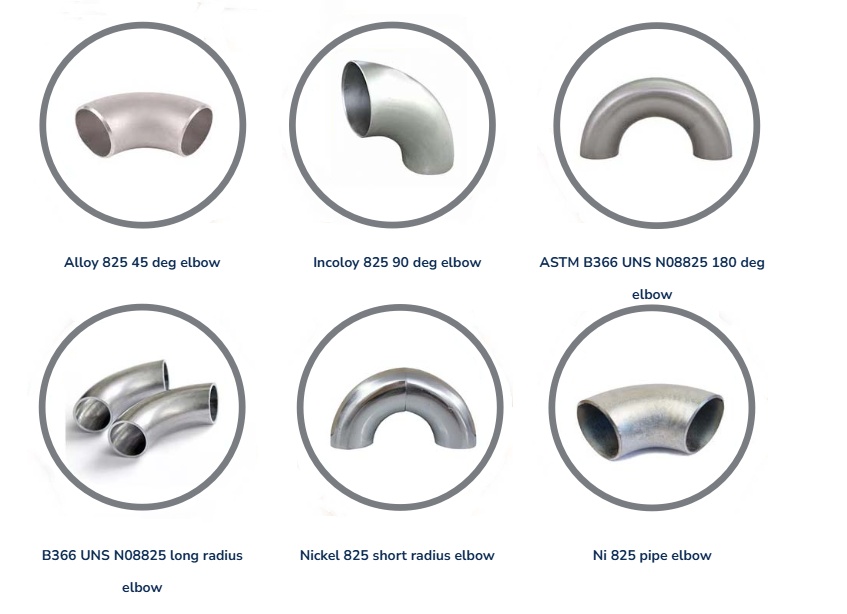
Common elbow types based on bend angle include 45° elbows, 90° elbows, and 180° elbows.
· 45° elbows are suitable for applications requiring a smaller turning angle, enabling pipes to change direction in confined spaces while minimizing fluid flow resistance;
· 90° elbows are the most common type, frequently used for right-angle turns. For instance, in building piping systems, 90° elbows are employed to alter pipe direction at wall corners;
· 180° elbows, also known as U-bends, enable 180° return flow, functioning to redirect fluid back to its starting point or a specific location.
Based on curvature radius, elbows can be further categorized into long radius elbows and short radius elbows.
· Long Radius Elbows: Their bending radius is 1.5 times the pipe diameter (R=1.5D). These elbows offer low fluid resistance and are commonly used where smooth fluid flow is required.
· Short Radius Elbows: Their bending radius equals the pipe diameter (R=1D). These elbows save space and are suitable for installations with limited room, but they present relatively higher fluid resistance.
Butt Weld Tee
A butt weld tee is a common pipe fitting. Its shape resembles a “T,” used to branch secondary pipelines from the main pipeline, thereby achieving fluid diversion or convergence. It connects to pipelines via butt welding, forming a robust, sealed, and continuous structure that ensures no leakage occurs when transporting high-pressure, high-temperature, or corrosive media. Based on whether the three ports have identical diameters, butt-weld tees are categorized into equal-diameter tees (all ports share the same diameter) and reducing tees (where the branch pipe diameter is smaller than the main pipe diameter).
Butt Weld Cross:
A butt weld cross is a specialized pipe fitting shaped like a “cross,” primarily used to connect four pipes at a single point, enabling fluid to diverge or converge in four directions. It features four outlets of identical or different diameters, all connected via welding to ensure a robust, leak-proof pipeline system.
Butt Weld Reducers:
Butt weld reducers, also known as welded reducers, are essential fittings for connecting pipes of differing diameters. They facilitate smooth transitions and flow regulation within piping systems. Based on whether the centerlines of connected pipes align, they are categorized as concentric reducers and eccentric reducers.
Butt Weld Caps:
Welded pipe caps serve as vital end-sealing components for pipeline systems. Their design eliminates internal threads or socket connections, instead utilizing beveled edges for direct butt welding to pipes. This creates seamless, highly sealed ends. Such connections ensure structural integrity, high strength, and superior leak resistance, enabling the system to withstand high-pressure, high-temperature, or corrosive media transport.
Buttweld Stub Ends:
The Buttweld Stub Ends features a flanged design on one end and a welded connection on the other. Paired with a slip-on flange, it enables flexible pipeline connections that are easy to disassemble and install. This configuration is ideal for pipeline connections requiring frequent maintenance or equipment replacement.
Advantages of Incoloy 825 Butt Weld Fittings
High Corrosion Resistance: Stable performance in sulfuric acid, phosphoric acid, alkali solutions, and chloride environments
Strength and Toughness: Maintains excellent properties even in high-temperature and low-temperature conditions
Long Service Life: Reduces maintenance and replacement costs
Standardized Production: Precise dimensions for easy installation and welding
Applications
Chemical processing equipment and acid reaction vessels
Oil and gas industry pipelines and pressure vessels
Seawater desalination and marine engineering
Pharmaceutical and food processing equipment
Heat exchangers, evaporators, and heating systems
You can get an offer for products in below material forms:
-Pipe and Tube (EN 10216-5, ASTM A213, ASTM A249, A312, A790,)
-Forged Fitting and Flange (ASTM A182 , ASTM A105,ASTM B564 )
-Butt Weld Fittings (ASTM A234, ASTM A403,ASTM A815)
-Round bar , Billet (ASTM A276, ASTM A479)
– Plate, Sheet, Strip(ASTM A240, EN 10028-7, A480)
-Bolting, Nuts(ASTM A193, A194, A320)
Incoloy 825 Butt Weld Fittings Exported Countries
We Export Incoloy 825 Butt Weld Fittings to Saudi Arabia, United Arab Emirates, Qatar, Bahrain, Oman, Kuwait, Jordan, Cyprus, Singapore, Malaysia, Indonesia, Thailand, Vietnam, South Korea, Japan, Sri Lanka, Maldives, Bangladesh, Cambodia, Argentina, Bolivia, Brazil, Venezuela, Colombia, Ecuador, Guyana, Paraguay, Uruguay, United States Of America, Canada, Mexico, Panama, Jamaica, Bahamas, Denmark, Norway, Germany, France,Italy, United Kingdom, Spain, Belgium, Greece, Czech Republic, Portugal, Hungary, Albania, Austria, Finland, Ireland, Croatia, Malta, Nigeria, Algeria, Angola, South Africa, Egypt, Europe, Africa, Asia, North America, South America, Middle East.etc